


3D Navigation Systems in Microsurgery: Overcoming Technical Barriers in Micro-Scale Manipulation
With continuous advancements in medical technology, microsurgery has become the primary method for handling complex and delicate surgical procedures. These surgeries, often performed in extremely small fields involving tiny blood vessels, nerves, and tissues, require an exceptionally high level of precision and control. However, even the most experienced surgeons face limitations in their visual and spatial perception when performing these delicate tasks. To address these challenges, 3D navigation systems are playing an increasingly important role in microsurgery.
What is a 3D Navigation System? A 3D navigation system integrates three-dimensional imaging, computer vision, and real-time positioning technologies to provide surgeons with precise surgical guidance. In microsurgery, the system generates real-time 3D images of the surgical field, helping surgeons accurately locate and manipulate target tissues, ensuring that every step of the procedure remains within a controlled range.
Challenges in Microsurgery
Microsurgery involves extremely small targets, such as blood vessels or nerve bundles only a few millimeters in diameter. These surgeries demand exceptional skill, as even the slightest deviation can lead to surgical failure or postoperative complications. While traditional surgical tools and microscopes can magnify the surgical field, they only provide two-dimensional images, lacking depth information, which increases the risk of error when handling complex anatomical structures.
Moreover, microsurgery often involves delicate physiological tissues with fragile and intricate anatomical structures. Relying solely on a microscope’s top-down view is insufficient, especially when surgical tools block the view. Achieving greater surgical precision requires integrating preoperative medical imaging with intraoperative surface data to enhance visualization. This provides surgeons with additional information to track surgical progress and assess the condition of tissues.
How Does a 3D Navigation System Work?
A 3D navigation system assists microsurgery through several key steps:
- 3D Imaging: Before surgery, the system generates a 3D model of the patient’s surgical area using imaging technologies like CT, MRI, or ultrasound. These models provide detailed anatomical information, helping surgeons pre-plan the surgical path.
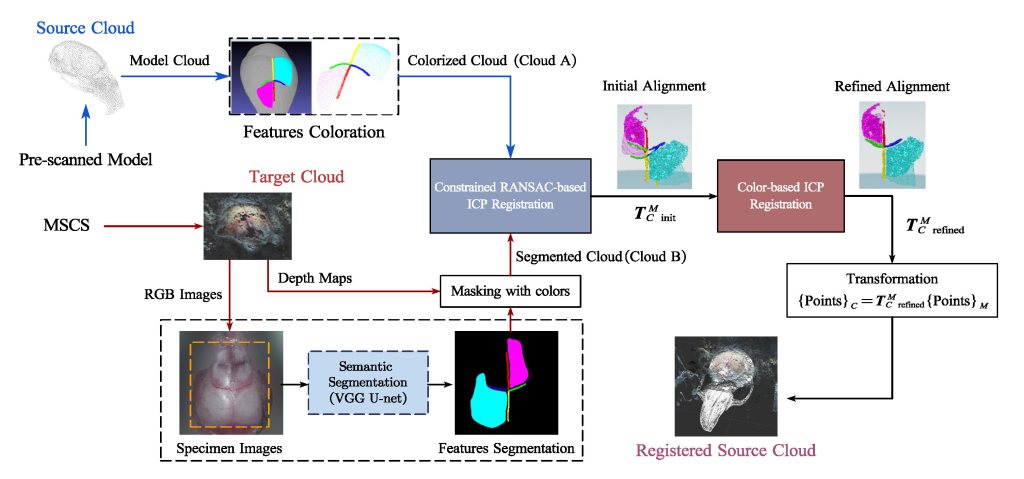
- Real-Time Navigation: During surgery, the system uses algorithms to continuously monitor the position of the target tissue and surgical tools, comparing them to the 3D model. Surgeons can view the relative positions of instruments and tissues on a screen, allowing for precise operation.
- Surgical Guidance: The system also offers real-time guidance to the surgeon, such as suggesting the best entry points or warning them to avoid critical structures, ensuring the safety and effectiveness of the procedure.
Advantages of a 3D Navigation System in Microsurgery
Compared to traditional surgical methods, the 3D navigation system offers several advantages:
- Improved Precision: By providing a 3D perspective and visual models with automatic registration, surgeons can more accurately judge the distance and angle between the instruments and target tissues, reducing the risk of errors.
- Enhanced Safety: The system monitors each step of the procedure in real time and alerts the surgeon to avoid critical structures like nerves and blood vessels, minimizing the risk of intraoperative injury.
- Reduced Surgery Time: As the system helps surgeons quickly identify the optimal surgical path, the overall procedure time is shortened, reducing the duration of surgery and the associated risks to the patient.
- Accelerated Learning Curve: For younger surgeons, the 3D navigation system serves as an excellent learning tool, helping them master the complexities of surgical techniques faster and gain more experience in live surgeries.
Technical Challenges and Future Directions
Despite the broad potential for 3D navigation systems in microsurgery, several challenges remain. First, the accuracy and real-time performance of the system need to be continually improved to handle more complex surgical environments. Second, simplifying the system’s complexity for easy adaptation across different types of surgeries is another area requiring attention. Furthermore, with the advancement of artificial intelligence, future 3D navigation systems may become more intelligent, capable of automatically adjusting and optimizing surgical plans during procedures, further improving success rates and safety.
 晓锋's Website